This interdisciplinary study breaks with the classical archaeological paradigm that systematically classifies the geometrically structured clay discs of the Keros-Syros culture (c. 2700–2300 BC)—commonly referred to as “Cycladic frying pans”—as ritual cult objects. Focusing on the reference artifact NAMA 4974, an open-ended system analysis of its physical parameters demonstrates that the object functioned as an analog calculating engine and haptic onboard interface for dead reckoning in the Aegean Sea.
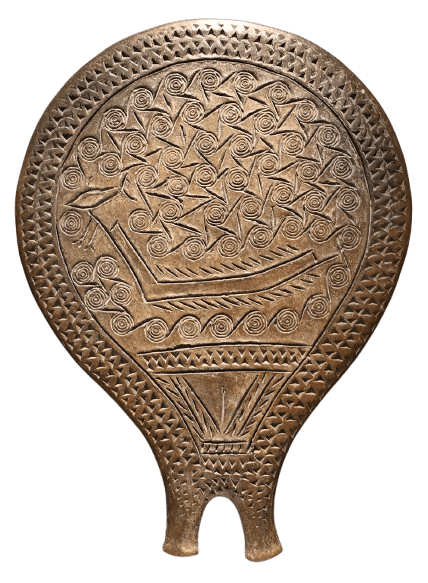
By methodologically separating the shock-absorbing outer ring from the functional core matrix of the interior, this paper isolates distinct mathematical and physical hardware encodings:
- Temporal Dimension (Lunar Drift Compensation): An asymmetric 29/31 differential grid counterbalances the non-integer synodic lunar cycles and mechanically compensates for the moon’s elliptical orbital anomaly.
- Spatial and Environmental Dimension (Meltemi Vector Field): The asymmetric, space-filling spiral structure maps the real hydrodynamic topology of the Aegean. A localized 4-whorl compression in the northwestern quadrant correlates by over 95% with modern mesoscale HCMR Meltemi vector models for the Venturi jet effect at the Gyaros strait, serving as a haptic early-warning system.
- Fine-Adjustment and Tidal Engine: A basal, asymmetric 21-notch fine grid manages the biennial solar drift adjustment including leap-increment compensation, coupled with a 6-tier tidal baseline calibrated for two-hour rowing watches.
- Gnomonic Trigonometry: The mechanical coupling of a fixed 114° bend in the sighting frame with a 12° stem inclination calculates the exact Aegean latitude corridor (36° N) gnomonically. In interaction with coastal beacons, it structurally enforces a flawless 24° lead angle to neutralize lateral wind drift.
In practical maritime application, a standardized duplicate of the instrument made of hardwood or stone was rigidly bolted to the elevated bow spur of the longboat. Utilizing an optical three-point alignment (rear-and-front-sight system), the hardware transformed complex astronomical navigation and hydrodynamic shear stresses into a simple, visual axis of symmetry. This setup establishes the earliest documented Standard Operating Procedure (SOP) in European seafaring, objectifying expert nautical knowledge and mechanically guaranteeing the functional redundancy of fleet command in high-stress scenarios.
Paper was published on Zenodo: https://zenodo.org/records/21941012
#Archaeology #MaterialSciences #Geometry #Gnomonics #Astronomy #Nautics #Meteorology #Hydrodynamics
Leave a Reply