The internal combustion engine (ICE) has been the workhorse of global mobility for over a century. Yet, despite decades of incremental engineering, traditional passenger car engines remain bound by a frustrating paradox: to meet stringent Euro 7 emission standards and fuel economy targets, they have become monstrosities of macro-mechanical complexity. Variable valve lifts, multi-stage exhaust gas aftertreatment, dual-stage turbocharging, and complex cooling jackets have driven production costs through the roof, while real-world thermal efficiency stubbornly stagnates between 25% and 32% during daily commuting.
We refused to accept that the ICE had reached its evolutionary dead end.
By tearing down traditional engineering dogmas and merging non-equilibrium plasma physics, transient wave mechanics, electrochemistry, and a radically simplified axial opposed-piston architecture, our research team has developed the ASTP-A 2.1. It is a pragmatic, cost-effective, and highly performant 110 kW (150 hp) powertrain designed specifically for the mid-size automotive market.
The most staggering metric? It achieves a real-world effective efficiency of 40.9% in its sweet spot and drops fuel consumption in a standard mid-size sedan to just 4.45 liters of gasoline per 100 km (approx. 53 mpg).
Open Source Licences:
– CC BY-SA 4.0 for the Technichal Documentation
– CERN-OHL-S v2 for CAD-Models, G-Code and Mechanics
– TAPR OHL for the SiC-Ignition module and the PCB Layouts
– GPLv3 for the MCU-Firmware and the Interrupt algorithms
The Architecture: Ditching the Crankshaft and Valves
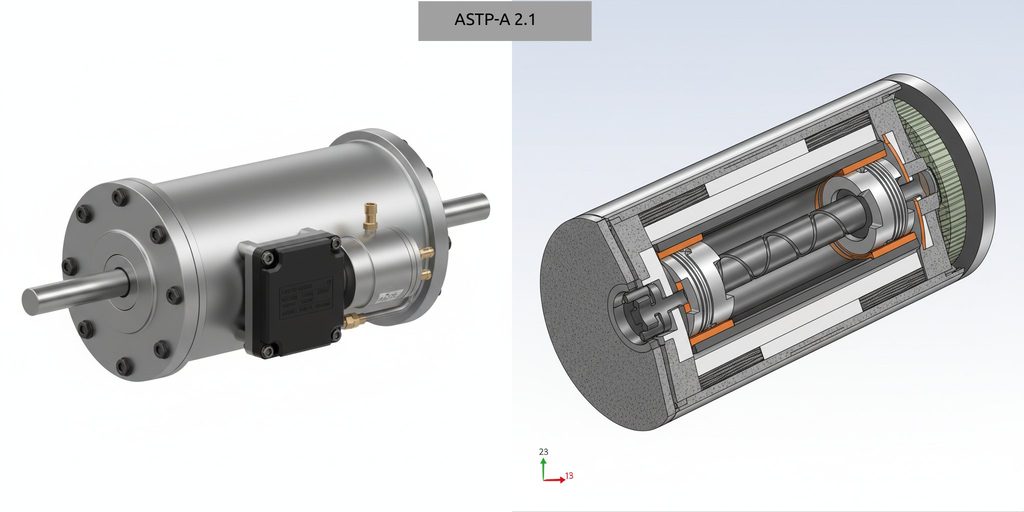
Look inside a conventional inline-four engine, and you will find over 150 moving parts—valves, springs, camshafts, timing chains, connecting rods, and a heavy crankshaft. The ASTP-A 2.1 replaces this entire mechanical grid with just seven moving core components: two pairs of opposed pistons, two pairs of guide shoes, and one central drive shaft running parallel to the piston motion.
+-----------------------------------------------------------------------------------+
|                           ASTP-A 2.1 Core Propulsion Mechanism                    |
+-----------------------------------------------------------------------------------+
          |                                                               |
          v                                                               v
[ "Tube & Shell" Chassis ]                                    [ Asymmetric Cam Drive ]
 - Extruded EN AW-6060 aluminum pipe                           - Nitrided 42CrMo4 central shaft
 - Monolithic GG-30 cast-iron core                             - 120° Compression / 240° Expansion
 - Pneumatic Vortex swirl management                           - Hydrostatic-centrifugal oil cushion
Instead of pushing down on a connecting rod to turn a crankshaft, the gegengegen-pistons move linearly inside a single, continuous cylinder sleeve. As they move, they press high-strength antimony-graphite slide shoes into a precisely machined, closed sinusoidal groove (kurventrommel) on the central shaft, converting linear thrust directly into pure rotation.
By geometry-coding the cam groove using cubic splines, we unlocked a radical thermodynamic cheat code: Stroke Asymmetry.
- Compression Segment: Steep and rapid, spanning just 120° of shaft rotation.
- Expansion Segment: Flattened and elongated, stretching over 240° of shaft rotation.
This means the expansion volume is physically three times larger than the compression volume (Atkinson/Miller principle). The burning gas expands far beyond conventional limits, extracting every ounce of kinetic energy from the thermal matrix and naturally cooling the exhaust gas to under 140°C purely through mechanical expansion.
Material Pragmatism: Re-Engineering for Mass Production
The first iteration of this concept (Version 1.0) relied on exotic, aerospace-grade materials like sintered silicon carbide (SSiC) monoliths and carbon-fiber-reinforced carbon (CFC) composites. It was an engineering masterpiece, but economically unviable for the mass market.
The Version 2.1 flips the script by utilizing affordable, strategically modified industrial standards. The target was strict: a prototype budget under €8,000 and a high-volume production cost under €2,000.
[ GG-30 Outer Sleeve ] ---> [ Shrink-Fitted 31CrMoV9 Inliner ] ---> [ Gas Nitriding (>1100 HV) ]
                                                                             |
[ Kapillar MoS₂ Solid Lubricant + FVMQ Elastomer Cushion ] <-----------------+
Instead of a solid ceramic block, the engine core utilizes a bimetallic split-liner technology. A thin-walled tube made of high-alloy nitriding steel (31CrMoV9) is thermally shrink-fitted into a structural sleeve of centrifugal cast iron (GG-30). Before assembly, the steel liner is electroplated with a 0,15 mm layer of porous sintered bronze. This ductile interlayer acts as a micro-yielding cushion, seamlessly absorbing the radial stress caused by differing thermal expansion rates when the engine is under full load.
The entire liner matrix then undergoes low-temperature gas nitriding. This is not a coating that can peel off; it is an atomic phase-transformation of the steel itself, creating a glass-hard surface layer (>1100 HV) that is completely impervious to wear and aggressive combustion radicals.
The Plasma-Steam Hybrid Combustion Cycle
The true magic of the ASTP-A 2.1 happens on an interdisciplinary level where fluid mechanics, acoustics, and cold plasma chemistry collide.
At 35° before top dead center (TDC), high-speed piezoceramic injectors spray a fluid shield consisting of 64 mass-% methanol and 36 mass-% water along the cylinder walls. Simultaneously, an external 60-kHz piezoelectric transducer acts as an acoustic coagulator, vibrating the droplets so they collide and form specific mass-optimized clusters.
Thanks to an intake vortex system that spins the incoming air to a high swirl ratio , the massive centrifugal forces (nearly 70,000 g) fling these dense fluid clusters to the outermost perimeter of the cylinder wall. This creates a perfectly stratified, cool liquid shield along the inner liner, while the thermal core of the cylinder remains completely dry and hot, ready for the primary fuel injection (gasoline or e-Fuel).
[ 24 kV CDI Circuit ] ---> [ Saturable ferrite choke ] ---> [ 45 ns Pulse Compression ]
                                                                       |
[ Isochoric volume ignition ] <--- [ Cold Non-Equilibrium Plasma (DBD) ] <+
At the exact microsecond of maximum compression, a custom-built SiC-Mosfet capacitor-discharge ignition (CDI) circuit fires a 24 kV pulse through a tungsten-molybdenum mesh embedded in the cylinder wall. By placing a saturable MnZn-ferrite choke (a magnetic sharpening switch) in series, the voltage rise-time is compressed from a sluggish 90 ns to under 45 ns.
This ultra-steep electrical field triggers a cold non-equilibrium dielectric barrier discharge (DBD). The accelerated electrons shatter the water molecules in the wall shield into hyper-reactive and radicals. The radicals rapidly crack the primary fuel chains in the core, while the radicals trigger an instantaneous, room-encompassing chain-branching reaction.
The result is a temperature-independent, purely volumetric isochore ignition. During the subsequent expansion stroke, these radicals exothermically recombine back into water (Δ H = -242 kJ/mol), releasing delayed thermal energy that superheats the expanding water vapor. This acts as a secondary built-in steam engine, flattening the p-V diagram into a smooth 140 bar pressure plateau that drives the pistons down with unprecedented mechanical efficiency.
Solving the Real-World Weak Spots
Engineering a groundbreaking engine means confronting hard physical limits. At the geometric dead-centers (TDC/BDC), the pistons momentarily stop, meaning the relative sliding velocity hits zero and the hydro-centrifugal PFPE oil cushion completely collapses. Under a brutal gas load of 70,371 N (approx. 7 tons), the graphite guide shoes face a massive peak contact pressure of 106.62 MPa.
To prevent catastrophic scuffing or mechanical failure, the ASTP-A 2.1 implements three passive, cost-effective safety systems:
- DLIP Laser Texturing: The nitrided steel liner is micro-structured around the dead-center bands using Direct Laser Interference Patterning (DLIP) to form a grid of cross-hatched pores (15 μm diameter, 3 μm depth). These pores act as capillary sponges that lock in the synthetic PFPE oil, ensuring a microscopic fluid film remains even during a complete standstill.
- MoS₂ Solid Lubricant: The nitrided cam track on the drive shaft is mangan-phosphatized and thermally bonded with a crystalline molybdenum disulfide (MoS₂) paste. If the liquid oil film ever tears, the hexagonal atomic layers of MoS₂ glide over one another with a microscopic friction coefficient of μ ≤ 0,03, entirely eliminating abrasive wear.
- FVMQ Elastomer Filter: The graphite guide shoes are mounted inside the AlSi25 piston skirts via a 0.4 mm thick fluorosilicone elastomer (FVMQ) pad. This pad acts as a mechanical low-pass filter, dampening high-frequency micro-shocks and vibration over 3.5 kHz by >18 dB, saving the brittle graphite matrix from micro-cracking.
In-Situ Emissions Purity: No Cat, No Filters, Euro 7 Ready
Because the endothermic evaporation of the water-methanol shield cools the immediate cylinder wall, the peak combustion temperature in the core is strictly capped at 1450°C. This creates a physical hard-lock against the thermal Zeldovich mechanism: thermal nitrogen oxides simply cannot form.
The ASTP-A 2.1 emits less than 10 mg/km of — crushing the upcoming Euro 7 limit of 60 mg/km by a factor of six, completely eliminating the need for expensive SCR catalytic converters or Urea (AdBlue) injection. Furthermore, because the primary fuel burns completely in a perfectly homogenized, dry plasma core without ever touching a cold wall, particulate matter (PM) and particle number (PN) emissions are absolute zero. No gasoline particulate filter (GPF) required.
The Bottom Line: Mass, Cost, and Future Outlook
The final, fully calculated bill of materials for the ASTP-A 2.1 proves that bleeding-edge thermodynamics can be scaled for commercial reality:
- Dry Engine Mass: 34.0 kg
- Power Density: 3.23 kW/kg (0.44 hp/kg)
- Prototype Cost (Single Unit): €7,855.00 (Safely under the €8,000 threshold)
- Production Cost (Batch of 1,000 units): €1,625.70 per engine (Safely under the €2,000 mass-market threshold)
+-------------------------------------------------------------------+
|               ASTP-A 2.1 Cost & Performance Matrix                |
+-------------------------------------------------------------------+
  - Mass: 34 kg                 \| - Cost (Series): €1,625.70
  - Power: 110 kW (150 hp)      \| - WLTP Consumption: 4.45 l/100km
  - Torque: 220 Nm (flat-curve) \| - NO_x Emissions: < 10 mg/km
By discarding traditional mechanical layout complexity and investing instead in highly automated, modern surface treatments and embedded electronic precision, the ASTP-A 2.1 shifts the automotive paradigm. Weighing a third of a conventional inline-four engine, matching the real-world fuel economy of an advanced diesel-hybrid without the battery weight, and running inherently clean of toxic emissions, it stands as a fully engineered blueprint for the future of sustainable, high-efficiency e-Fuel mobility.
#AutomotiveEngineering #MechanicalEngineering #Thermodynamics #Powertrain #Innovation #CleanTech #MassProduction #DeepTech #AI #MachineDesign #Motor #Engine #TechnicalDesign #EcoTech #FutureTech