Polyethylene Terephthalate (PET) is the most widely recycled plastic globally, primarily driven by the massive volume of single-use beverage bottles. Statistically, it represents the clearest success story in the circular economy. However, from a materials science perspective, PET is a highly sensitive and challenging polymer.
Unlike more forgiving polyolefins like High-Density Polyethylene (HDPE) or Polypropylene (PP), PET requires precise thermal and chemical control. This technical analysis explores the industrial realities of PET recycling, the degradation mechanisms that limit its lifecycle, and the economic hurdles of closed-loop systems.
🔬 1. The Core Scientific Challenge: Hydrolytic Degradation
PET is a polyester, formed through a condensation reaction where polymer chains link together via ester bonds while releasing water. When PET is collected, re-melted, and re-extruded during the mechanical recycling process (typically between 250°C and 260°C), this chemical process reverses instantly if even trace amounts of moisture are present.
🧪 The Hydrolysis Mechanism
If PET flakes are melted with a moisture content above 0.005% (50 ppm), hydrolysis occurs. The water molecules actively sever the ester linkages, cutting the long polymer chains into significantly shorter fragments.
- The Mechanical Implication: As chain length decreases, the intrinsic viscosity (IV) of the material drops. The molten plastic loses its structural stability, becoming highly fluid in the machine and extremely brittle upon cooling.
- The Industrial Response: To prevent this, industrial recyclers must subject PET to energy-intensive, long-duration desiccant drying systems to extract all moisture before the extrusion phase begins. This technical requirement renders PET completely unsuited for small-scale, decentralized, or DIY recycling setups.
⚙️ 2. The Mechanical Recycling Process Chain
Industrial mechanical recycling is highly optimized, yet it remains vulnerable to material cross-contamination. A standard processing plant relies on a rigorous multi-step sequence to maintain material grade:
- Automated Optical Sorting: Near-Infrared (NIR) sensors sort incoming bottles by polymer type and color. Clear, light blue, green, and opaque PET must be strictly separated. Colored pigments reduce the market value and mechanical properties of the output resin.
- Decontamination and Washing: High-temperature caustic washes are required to remove adhesives, paper labels, and organic residues. Even minor residues of PVC or polyolefin bottle caps (PP/PE) can ruin an entire batch. PVC is particularly problematic; at PET melting temperatures, PVC degrades into hydrochloric acid, destroying the recycling equipment and turning the PET black.
- Solid State Polycondensation (SSP): Mechanical extrusion inevitably degrades the polymer chains to some degree, lowering the intrinsic viscosity. To restore food-grade mechanical properties, the recycled pellets undergo SSP. The material is heated under a deep vacuum or an inert gas blanket just below its melting point for up to 24 hours. This drives a solid-state reaction that reconnects the broken polymer chains, lengthening them to meet international food safety and structural standards.
🔄 3. The Downcycling Reality vs. Closed-Loop Systems
True “Bottle-to-Bottle” recycling—where an old beverage container becomes an identical new one—is strictly regulated by food safety authorities (such as the FDA and EFSA). Due to the risk of the plastic absorbing environmental toxins during its initial use, only highly advanced, certified decontamination processes can produce food-grade recycled PET (rPET).
Because of the high capital expenditure required for food-grade processing, a vast percentage of recycled PET is diverted into non-food applications. This is known as Downcycling:
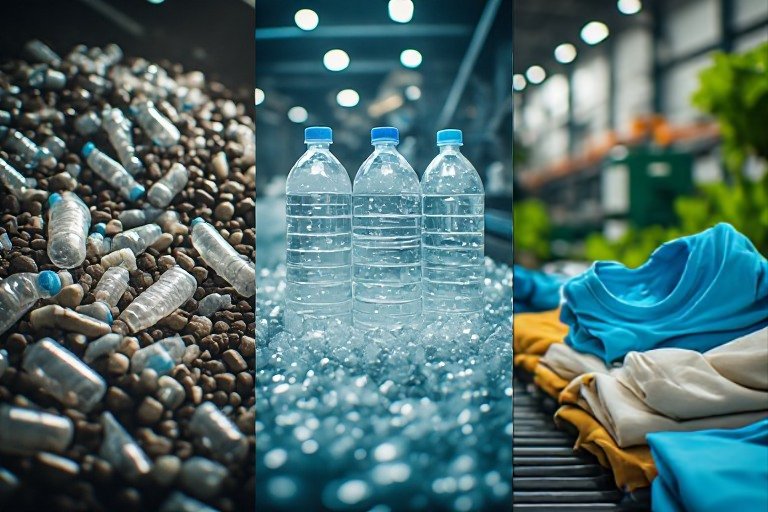
- The Textile Route: The majority of global rPET flakes are converted into polyester fibers for clothing (fleece, sportswear), carpets, insulation materials, and automotive interiors.
- The Linear End-Point: Once PET is spun into a textile fiber—especially when blended with other materials like cotton or elastane—it reaches a technical dead end for mechanical recycling. Current sorting and processing technologies cannot separate blended textile waste at scale. Consequently, most polyester garments are ultimately landfilled or incinerated, breaking the circular loop entirely.
⚗️ 4. Advanced Chemical Recycling (Depolymerisation)
To overcome the inherent limits of mechanical recycling, the industry is increasingly investing in chemical recycling methods, such as glycolysis, methanolysis, or hydrolysis.
Instead of melting the plastic, chemical recycling uses solvents, heat, and catalysts to break the polymer chains back down into their raw monomer building blocks: Terephthalic Acid (PTA) and Monoethylene Glycol (MEG).
- The Advantage: Chemical purification filters out all dyes, additives, and cross-contaminants perfectly. The resulting monomers are chemically identical to those derived from crude oil, producing virgin-quality PET.
- The Disadvantage: These processes are highly capital-intensive, require significant chemical inputs, and consume vast amounts of energy. From a carbon footprint perspective, chemical recycling is far more demanding than mechanical processing. Consequently, its economic viability fluctuates heavily with global oil prices and legislative quotas regarding mandatory recycled content.
💡 Summary Analysis
PET recycling is a highly sophisticated industrial achievement, but it operates under unforgiving chemical constraints. The material cannot be infinitely processed via mechanical means without continuous chemical and structural intervention. For the foreseeable future, maintaining a functional PET loop relies on two parallel necessities: strict deposit-return infrastructure to ensure feedstock purity, and continuous technological upgrades to mitigate thermal degradation.
cheers
Leave a Reply